


Imagine that one fine November day, you leave the school campus with your book bag and bike down to a nearby coffee shop. The café is across the street from a popular shopping mall. It is a sunny day, so despite the chill in the air, you take your coffee and sit outside at a table on the side walk. There are three or four others sitting outside as well, all dressed for cold weather.
Imagine that as you are drinking your coffee and enjoying the day, a police cruiser stops in front of you. Two officers exit the vehicle and walk towards you. They ask you to stand up and show them a driver’s license or personal identification. You comply. They review your documents and inform you that they are going to pat you down. You are forced to turn around and place your hands behind your head. While one officer pats you down for weapons, the other asks you the contents of your backpack. You tell him that it is full of school books and he tells you to show him. You again comply. The officers return your ID and tell you to go about your business. When you inquire as to the reason for this treatment, they tell you that you were loitering in a public throughway (the street in front of the café), carrying a suspicious object (your backpack) and possibly casing a target (the shopping mall).
The policemen return to their vehicle and drive off. The people at the café continue to stare at you. A week later, you are stopped again as you are about to enter a movie theater. You’ve been racially profiled: “Young white male” is the profile most likely to carry out a mass shooting in a public venue or to blow up federal buildings.
But there is no need to imagine this scenario: it occurs over 680,000 times per year in New York City.

“Stop, Question and Frisk”
That is the approximate number of UF-250 forms[1] (i.e. “Stop, Question and Frisk”) filled out by NYPD officers in 2011.[2] Since the program was instituted in 2002, over 4.4 million stops[3] have been reported, though the actual number of New Yorkers subjected to this treatment is undoubtedly lower as many citizens have been stopped multiple times.
Supporters of “Stop and Frisk” claim that the program has significantly reduced crime rates, seized thousands of weapons and had a positive effect on the safety and security of New Yorkers, especially in those neighborhoods with the highest crime rates. However, detractors argue that it is both illegal and unconstitutional; not only inefficient but ineffective. Making the argument even more incendiary is the fact that African-Americans and Hispanics are those principally impacted by the program: due to racial profiling argue civil rights advocates; due to the fact that the majority of violent crimes are committed by African-Americans and Hispanics, argue defenders.
How valid are the arguments on either side?
New York has seen a significant decline in violent crime, including murder and all categories of assault[4]. The Big Apple has gone from being one of America’s most dangerous big cities to one of the safest, and New York’s Finest deserves its share of the credit. That being said, there is little statistical evidence to support the claim that the “stop and frisk” policy has had much to do with it.

Assault rates in New York peaked in 1988 and murder rates in 1994[5]; thereafter, both types of crime fell consistently and continuously until 2004. Between 2004 and 2008, the assault rate continued to fall, though at a much lower rate than previously while the murder rate increased slightly. After the 2008 Financial Crisis and the resulting recession, both the murder and assault rates began to increase slightly.
The major gains in safety were had during the mid- to late-1990’s, well before the “stop and frisk” policy was even enacted. These were the boom years of the Clinton economy, the time of greatest wealth generation and lowest unemployment since the end of the Second World War. With the end of the boom in 2001, the gains in safety began to wane until the recession brought hard times and increased crime. This narrative is wholly consistent with the well-established link between poverty and crime. “Stop and frisk” does not appear to have made the least difference in either trend.
There is no denying that New York has reduced crime impressively: NYPD had the 2nd largest decline in the murder rate and 8th largest decline in assault rates of US cities with a population over 500,000. Yet New York is not unique in becoming a safer metro: Los Angeles, Dallas-Fort Worth, San Francisco – even much maligned Chicago experienced comparable decreases in violent crime. But considering that New York alone has instituted the policy of “stop and frisk” and New York alone continues to declare it a shining example of success, one would have expected a greater disparity in results.
The 9 metro police departments with the largest average decrease in both murder and assault rates[6]:

New Yorkers are divided on the subject. In a recent Quinnipiac poll[7], people interviewed expressed considerable support for Ray Kelly as Police Commissioner[8] (avg. 65% approval) as well as for the NYPD[9] (avg. 60% approval). In both cases however, there was a political and racial separation: Republicans expressed +20% greater approval than Democrats, and whites expressed 30%+ approval versus African Americans and Hispanics.
Less division is even more visible with regards to the “stop and frisk” program itself. Here, a bare majority of New Yorkers are against the program (51% disapprove); but the Republican/Democrat split is almost 50%(!) while the white/black-hispanic split averages 30%[10]. This poll supports the finding of an earlier New York Times poll which gave the mayor and the police lower marks for race relations in the city, with even a plurality of whites agreeing that “stop and frisk” excessively targeted ethnic minorities[11].
“Stop and frisk” is not merely a popularity contest, it has important constitutional implications. The Fourth Amendment to the Constitution states:
“The right of the people to be secure in their persons, houses, papers, and effects, against unreasonable searches and seizures, shall not be violated, and no Warrants shall issue, but upon probable cause, supported by Oath or affirmation, and particularly describing the place to be searched, and the persons or things to be seized.”[12]
Stopping and searching an individual is not unconstitutional in and of itself. A number of Supreme Court cases have upheld the constitutionality of reasonable stops. The central issue then is the definition of “reasonable” and whether the NYPD is being “unreasonable” in the application of the program.
In Terry vs. Illinois (1968) [13] the Supreme Court concluded that the Fourth Amendment absolutely applies to all variations of “stop and frisk”.[14] It further held that the police must have “specific and articulable facts which…warrant the intrusion.” The Court recognized that the exigencies and dangers of police work made fairly wide latitude in the application of a reasonableness test necessary, yet at the same time declaring:
“The reasonableness of any particular search and seizure must be assessed in light of the particular circumstances against the standard of whether a man of reasonable caution is warranted in believing that the action taken was appropriate.”
The Court recognized that no perfect test or standard exists for determining reasonableness in al situations[15]. However, the latitude extended to an officer to investigate suspicious behavior and to ensure their safety in the performance of their duties does not extend to condoning inarticulate “hunches”; else the infringement of constitutionally sanctioned privacy would be constant and utterly at police discretion:
“We may assume that the officers acted in good faith. But good faith on the part of the arresting officer is not enough. If subjective good faith alone were the test, the protections of the Fourth Amendment would evaporate, and the people would be secure in their persons, houses, papers, and effects, only in the discretion of the police.”[16]
Under this definition, is it possible to state that New York’s “stop and frisk” constitutes an unreasonable basis for search and seizure? There are two key arguments that support this view:
- First is the vast number of stops: 685,000 in 2011 alone, compared with 97,000 in 2002.
- Second is the very low effectiveness ratio: only 10% of stops resulted in an arrest or ticket while only 0.5% of stops yielded a firearm during the search. This is far worse than the confiscation ratio during Mayor Bloomberg’s first year in office (2002) before “stop-and-frisk” became policy.[17]
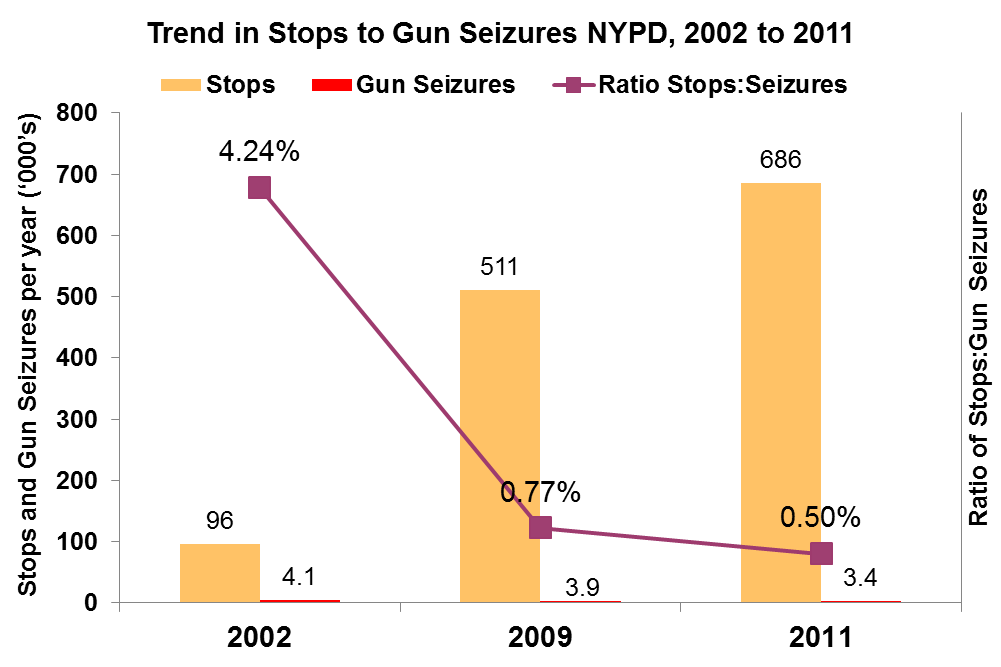
A reasonable person would argue that so vast an increase in stops precludes the possibility of reasonable criteria being applied in each and every case, and the evidence of the second point would strongly support that argument.
But “stop-and-frisk” is leading to at least some arrests and some confiscations. Isn’t that enough to justify the measure? Certainly not says the Supreme Court, writing in the majority opinion of Illinois v. Lidster[18]: Justice Breyer wrote the majority opinion stating that stops – in this case a traffic checkpoint – set up for the purpose of “general crime control” are unreasonable under the Fourth Amendment. The fact that so miniscule a proportion of stops are leading to seizures, arrests or tickets lends great weight to the argument that “stop-and-frisk” is pursuing a policy of general crime control, rather than acting on articulable suspicions.
Judge Shira A. Scheindlin, of the US District Court for the Southern District of New York, concurred with these arguments in the class action suit brought against the City of New York in Floyd, et.al. v City of New York, et.al. In her ruling, Judge Scheindlin found that the NYPD’s practice violated both the plaintiffs’ Fourth Amendment rights, but also their Fourteenth Amendment rights to equal status before the law, because of the evidence of “indirect racial profiling” through a disproportionate and discriminatory targeting of racially defined groups[19] (not only unconstitutional, but illegal under New York state law as well).
Mayor Bloomberg immediately filed an appeal of the ruling, and the Second Circuit Court of Appeals found in favor of the City[20]. However, the three judge panel did so because it found that Judge Scheindlin had not maintained the requirements that judges avoid even the appearance of impropriety, due to statements she had made and interviews given prior to the decision. In other words, the ruling was not overturned due to a difference in Constitutional interpretation.
For the moment, “stop and frisk” continues. However, Mayor-Elect Bill di Blasio has promised “meaningful reform” of the controversial policy, including an independent inspectorate to oversee the application of the policy as well as citizen concerns. This was one of the key mandates in Judge Scheindlin’s ruling as well. Mr. di Blasio takes office on the 1st of January, 2014, but the NYPD is a big organization and it moves with the nimbleness of a supertanker – we should not expect the situation on New York’s streets to change very quickly.
But the program should be stopped, not “reformed”. Police already have the authority and latitude they need to stop suspicious subjects and check for dangerous weapons, without the need to formalize it into a quota system targeted overwhelmingly at ethnic minorities. A failed policy which does not, by any statistical measure, contribute meaningfully to the safety of New Yorkers. Even if it were the main driver in the reduction of crime rates, our hard-fought constitutional rights are too important to be cast aside for the government’s convenience. Admit that argument, and you admit unauthorized wiretapping, warrantless searches, and video cameras in the privacy of your home – all undoubtedly effective ways of reducing crime.
New York’s Finest have a difficult and dangerous job to do, and they do it in exemplary fashion through great personal and family sacrifice. There is no need to sully their sterling reputations with so dubious a policy. End “stop and frisk” now; demonstrate that public safety, good police work and constitutional liberties are still compatible in our country.
Sources and Notes
[1] Scanned image of a UF-250 form:
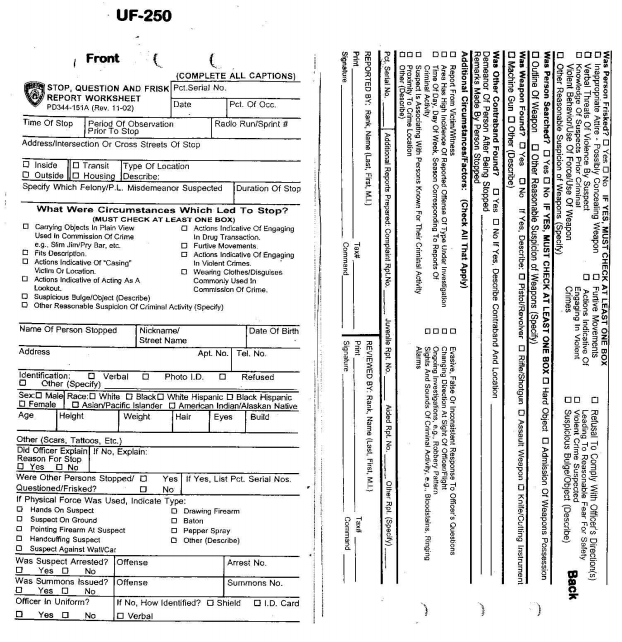
[2] NYPD Stop, Question and Frisk Report Database
[3] Ibid
[4] The FBI’s Uniform Crime Reporting system (UCR) lumps together “simple assault” – where no weapon is used and no or minor injury results – and “aggravated assault” – where a weapon is used and/or significant injuries are sustained.
[5] Uniform Crime Reporting Statistics – UCR Data Online: Murder and Aggravated Assault
[6] For the sake of comparison, I am including the remainder of the top 27 US metros with populations greater than 500,000. Louisville, Las Vegas and Charlotte-Mecklenberg do not appear on the list because of reporting discrepancies and lack of data:


[7] “New York City Voters Back NYPD Monitor More Than 2-1”, Quinnipiac University Poll, 11 April 2013


[10] 
[11] Michael M. Grynbaum and Marjorie Connelly, “Majority in City See Police as Favoring Whites, Poll Finds”, New York Times, 20 August 2012
[12] Fourth Amendment to the Constitution of the United States of America
[13] Terry v. Ohio, 392 U.S. 1, at 30.
[14] The Court held that “”whenever a police officer accosts an individual and restrains his freedom to walk away, he has ‘seized’ that person.” Also that “… it is nothing less than sheer torture of the English language to suggest that a careful exploration of the outer surfaces of a person’s clothing all over his or her body in an attempt to find weapons is not a ‘search.’”
[15] “No ready test for determining reasonableness other than by balancing the need to search [or seize] against the invasion which the search [or seizure] entails.”
[16] Beck v. Ohio, 379 U.S. 89 (1964)
[17] Weiss, Murray, “Stop-and-Frisks Fail to Pull More Guns Off the Street, NYPD Stats Show,” DNAinfo New York, 13 August 2012
[18] Illinois v. Lidster, 540 U.S. 419 (2004)
[19] Vaughan, Bernard, “NYPD’s ‘stop-and-frisk’ practice unconstitutional, judge rules”, Reuters, 12 August 2013
[20] Chris Boyette and Michael Martinez, “Court blocks ruling that altered NYPD’s stop-and-frisk policy,” CNN, 3 November 2013


Crime and Punishment by Fernando Betancor is licensed under a Creative Commons Attribution-NonCommercial-ShareAlike 4.0 International License.


Discussion
No comments yet.